Newburyport sits where the Merrimack River meets the Atlantic, with Plum Island and the Great Marsh just to the east. That's a big part of why people love living here. It's also why the outdoor half of your mini-split works in tougher conditions than the same unit would a few towns inland.
What the condenser actually does
Every mini-split has two halves. The indoor unit moves air through your room. The outdoor condenser moves heat in or out of the house through a coil made of thin aluminum fins. Air has to pass freely through those fins for the system to work efficiently. Anything that coats or blocks them makes the whole system work harder.
How salt air affects it
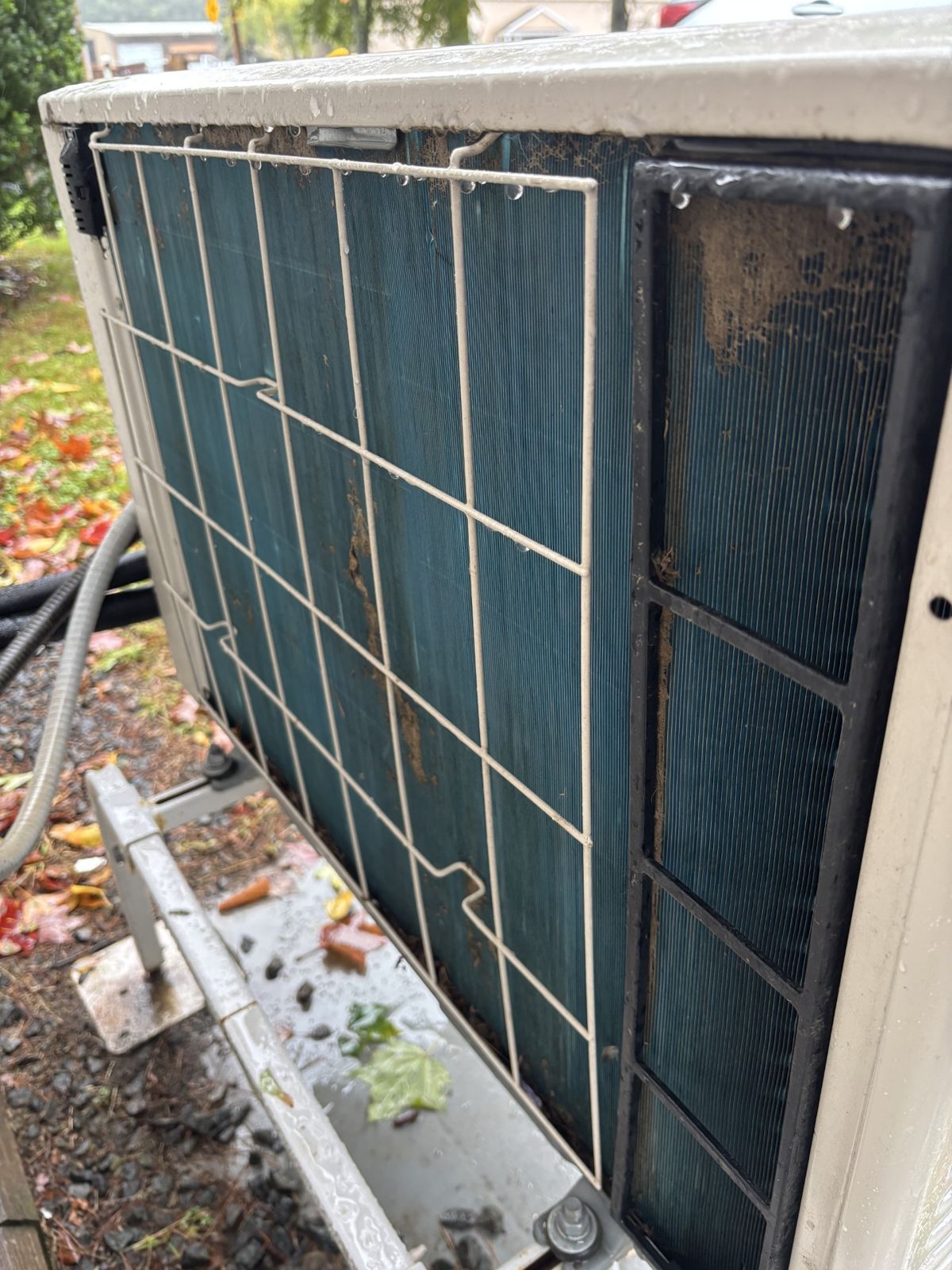
Air near the coast carries fine salt particles. Over time they settle on the condenser coil, cabinet, and line set, and they hold moisture against the metal. That film also traps pollen, dust, and grass clippings, which build up into a layer that restricts airflow.
In Newburyport this tends to show up most on homes in the South End, along the waterfront, and out toward Plum Island, but marsh humidity and wind carry salt well inland too.
Signs your condenser needs attention
- A visible gray, white, or brown film on the coil fins.
- Leaves, grass, or debris packed against the back or sides of the unit.
- Discolored or weathered insulation on the refrigerant lines running into the house.
- The system running longer to reach the temperature you set.
What you can safely do yourself
- Keep about two feet of clear space around the unit. Trim back shrubs and move anything stored against it.
- Clear leaves and debris by hand with the power off.
- After a storm, check that the unit isn't buried in debris or sitting in standing water.
Skip the pressure washer. The fins on a condenser coil bend easily, and bent fins block airflow just like dirt does. A garden hose on a gentle setting is fine for a light rinse, but a real coil cleaning uses a cleaner made for coils and a controlled rinse.
How often to clean it
For most Newburyport homes, once a year is a good baseline, ideally in spring before cooling season. If your home is right on the water or near the marsh, check the coil again in the fall.
When we clean a condenser, we clear the area, clean the coil with an eco-friendly coil cleaner, rinse it at low pressure, and check the line set and cabinet for anything worth keeping an eye on.
The U.S. Department of Energy also recommends keeping the outdoor coil clean and clear of debris as part of regular air conditioner maintenance.
Common Questions
How often should I clean my mini-split condenser in Newburyport, MA?
Once a year is a good baseline, ideally in spring before cooling season. Homes on the waterfront or near Plum Island and the marsh should check the coil again in the fall.
Can I pressure wash my condenser?
No. Condenser fins bend easily, and bent fins block airflow. A gentle garden-hose rinse is fine for light dust, but a real cleaning uses a coil cleaner and a low-pressure rinse.
Do you clean condensers on Plum Island?
Yes. We clean mini-splits and condensers on Plum Island and throughout Newburyport and Newbury.
Live in Newburyport? See our Newburyport, MA mini-split & condenser cleaning page.
We also clean mini-splits and condensers near Newburyport in Newbury, MA, Salisbury, MA, Amesbury, MA, Rowley, MA, Seabrook, NH.
Ductless Brothers cleans mini-splits and condensers across Newburyport, MA, the New Hampshire Seacoast, and Southern Maine.